
Can you swim breaststroke in a triathlon? What are the best techniques for swimming breaststroke in a triathlon? What are the best wetsuits for swimming breaststroke in a triathlon? Could you even swim breaststroke in an IRONMAN or a 70.3?
These are questions that many new, or aspiring triathletes will have. As a British Triathlon High Performing Coach and Level 2 swimming teacher who has taught thousands of people to swim both strokes, I wanted to answer those questions one by one.
Can you swim breaststroke in a triathlon?
Yes! You can swim breaststroke in any triathlon. Even an IRONMAN. The only stroke that is (generally) banned is backstroke. You can check the competition rules here, or the IRONMAN competition rules here if you need some reassurance.
Breaststroke is an accessible swim stroke that allows thousands of athletes to participate in the sport who would not be able to otherwise.
Is breaststroke for triathlon efficient?
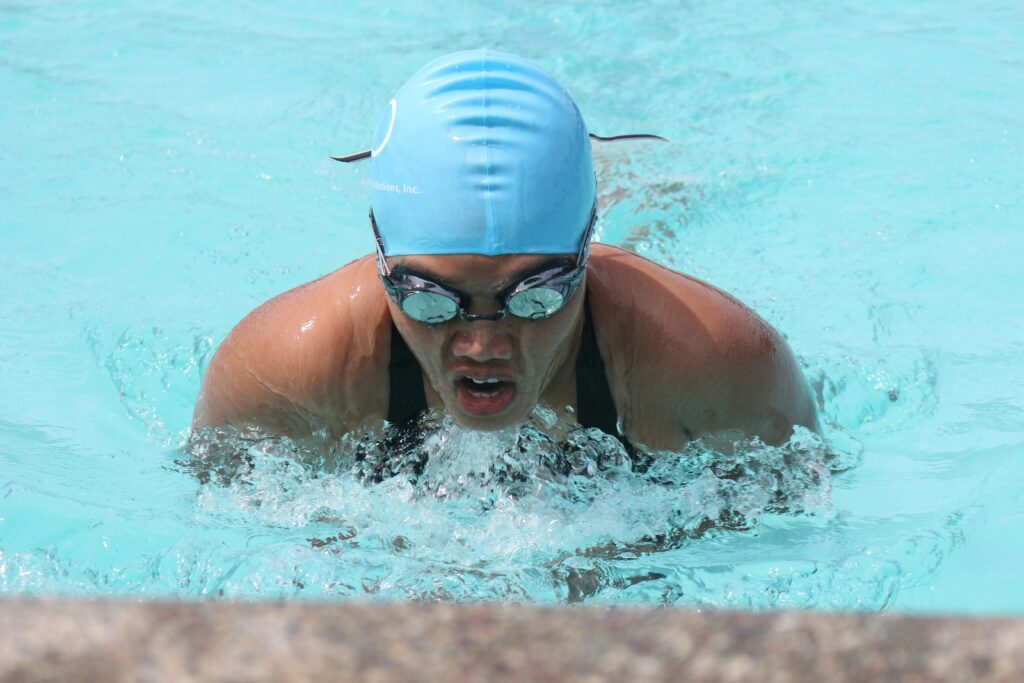
No, it is not. There are two types of breaststroke people will generally swim. There is regular breaststroke, and there is heads up breaststroke.
Regular breaststroke is actually quite rarely seen, as most people who can swim it well can also swim freestyle (front crawl). The reason is that freestyle is a much faster and less exhausting stroke. Most people will only swim breaststroke when competing against other breaststroke swimmers. Swimming breaststroke in a competition where you can swim freestyle is like brining a knife to a gunfight.
The men’s Olympic breaststroke record over 200M is 2:05.85, set by Léon Marchand. The 200M freestyle record is 1:42.96, set by Michael Phelps. Even the world’s fastest breaststroke swimmer is over 20 seconds down on the fastest freestyle swimmer. When you extrapolate this difference over the 3800M of an Ironman swim, even the very best breaststroke swimmers in the world would be over seven minutes down on the fastest freestyle swimmers.
But if you’re reading this, you’re not interested in going fast. You probably just want to get round your first triathlon.
Most who are in this position will swim heads up breaststroke. This is quite a different stroke, where the head does not go underwater at any point. Where competition breaststroke will be slow in itself, heads up breaststroke will feel like a glacial pace relative to freestyle swimmers.
Top breaststroke tips for triathlon
If we want to get faster, we need to break our stroke down into elements.
Head Position
The reason breaststroke is so slow is because we are swimming at such an angle. Our head high, and our legs low in the wate, causing high levels of drag. The number one thing we can do to lower our body position in the water is to flatten our body position. This starts with lowering the head.
Instead of swimming with your head out of the water, the best thing you can do is place it in the water. Your head should be fully submerged, with the exception of when you are breathing.
The issue with this is that many people swim heads up breaststroke explicitly because they do NOT want to put their face in the water. Whether this is because they want to keep their hair dry or they panic when their face is in the water.
However it is impossible to swim efficient breaststroke with your head out of the water. It will be painfully slow, and leave you with neck pain. It is fine in short bursts if someone has a bit of a panic or needs to take a proper look around them. But in an ideal world, this should be kept to a minimum.
For tips on placing your face in the water, check the bottom of this article.
Legs
In breaststroke, your legs provide you with the majority of the propulsion. So it’s critical that we get our leg kick right.
The mistake many swimmers make is that they kick out very wide in a circle. Instead we want to kick in much more of an oval shape. Keeping it narrower makes it more efficient, as it means you spend more time actually pushing water behind you. This is what creates propulsion.
You also want to ensure that your feet point outwards slightly when they are close to your buttocks before initiating the kick, and that you really kick hard to propel yourself.
Arms
The arm action is breaststroke is secondary to the kick, but we can’t ignore it.
The arm action starts at your chest where you hold your hands at your sternum with palms together in a praying position. From here you thrust your hands forward, until they are fully extended. Once your arms are extended you want to bend your wrists until your fingertips are pointing down.
From this position, you use your hands as paddles and sweep your arms out to the side. Not too wide though, you don’t want to go much past your shoulder width. Once your hand are this wide, you then pull them straight back towards your chest, to begin the motion again.
It is important that you keep your palms flat and fingers pointing down during the pull. This is what actually moves water behind you. Keeping your elbows high in he water will maximise the effect of this pull, and help you move faster.
The advantages of breaststroke in triathlon
While breaststroke is an inefficient, slow stroke, there are a few advantages to it.
Firstly, it helps make the sport more accessible. Thousands of people can get involved in the sport who wouldn’t be able to otherwise if it weren’t for breaststroke. Most athletes will start with breaststroke, and move onto freestyle when they want to get faster.
It also reduces the level of panic triathletes are liable to feel in open water. Even if you intend to swim your event freestyle, switching to breaststroke for a bit to calm the panic you may encounter after being hit by another competitor can really help you calm yourself.
You also have much better visibility when swimming breaststroke, as your eyes will be looking forward whenever you lift your head to take a breath. When swimming freestyle you have to lift your head to sight intermittently, but with breaststroke you can sight with every stroke.
The best triathlon wetsuits for breaststroke
Most triathlon wetsuits are designed for freestyle swimming, but this does not make them comfortable for breaststroke swimming, which uses a completely different motion.
As a result, some manufacturers have created breaststroke specific wetsuits, for those who have zero desire to ever learn to swim freestyle.
Zone 3 were the first on the scene with their Aspect wetsuit, but at the time of writing there is only zone size left (women’s XS) for £40, so it seems they are discontinuing the model. However, they may be re-stocking or redesigning it.
Orca have also created a breaststroke specific wetsuit. The Vitalis is in stock and currently retailing for £199.
There are much cheaper wetsuits available such as those that use fabrics or are for surfing, but these will be very restrictive and provide a negative experience.
Considerate breaststroke in triathlon
Around 90% of the field will be swimming freestyle, and as such they expect other athletes to be swimming freestyle.
When you are swimming breaststroke, you run a very real risk of kicking other competitors. As you will be swimming so much slower, they may approach you at a rate of knots, and only know you’re there when you kick them in the face with a powerful breaststroke kick. As I’m sure you can imagine, this is not on the list of experiences anyone wants to have.
If they do manage to spot you, they will try to swim around you, but even then they’re not out of the woods. If you kick your legs out wide, you can still give them a good, hard kick.
I’m afraid you can’t simply expect people to look where they’re going, you are very much in the minority as a breaststroke swimmer and have the potential to cause quite a lot of damage to other athlete. As a result, it is your responsibility to place yourself where you pose as little risk to other athletes as possible.
If you are swimming breaststroke, please keep off of the racing line. This is the shortest route that a swimmer can take to get around the course. Swim a couple of metres off to the side. This has two benefits.
Firstly, you will not be putting other athletes in danger of being kicked. It will make you slightly slower as you are taking a wider line, but if you’re swimming breaststroke, you’re not overly concerned about your finish time. This is especially important a turn buoys where there will be a huge concentration of swimmers.
More importantly, it will keep you out of trouble. One big issue for slower swimmers is being swum over by faster athletes. This is where a faster athlete approaches at speed, and goes straight over the top of you, summering you under the water. This is straight up terrifying, but can be avoided by staying off of the racing line. You will also be closer to the water safety crews here, making it easier to get help.
Why I don’t want you to swim breaststroke in your triathlon
Breaststroke is a means to an end. It will help someone get started in the sport, but as I have already mentioned, it’s painfully slow and inefficient.
You will come out of the water feeling very stiff and tired, way behind your competition. Even if you’re not trying to be competitive, it’s not a great feeling. If you are taking on a 70.3 or IRONMAN, you may struggle to swim fast enough to make the cutoff. I have seen several swimmers fail to meet the cutoff at IRONMAN events due to swimming breaststroke.
If you only have a handful of months until your triathlon, I hope these tips will help you become faster and more efficient in the water. But if you’re signing up to an event with six months or more to go, I need you to back yourself. I want you to learn freestyle (front crawl).
For many, this conjures up horrible images and flashbacks. Swallowing water, panic attacks, feeling exhausted at the end of each length, the list goes on.
I was the same. When I started training for triathlon I couldn’t swim a length of freestyle, I just swam breaststroke. Very slowly.
I didn’t get swimming lessons, my parents decided to teach me to swim themselves. They gave up teaching me freestyle, they called me the windmill, as they couldn’t get me to bend my arms, or slow down at all. Breathing was non existent, and it was just a struggle. I had horrible memories of trying to learn, but when I signed up for a triathlon, I decided that things had to change.
I taught myself to swim freestyle without paying for a coach. This included reading books, watching videos, and applying myself ruthlessly. I had the arrogance of youth behind me at the time (I was 22), so felt like I could achieve pretty much anything if I put my mind to it, but that didn’t stop it being a struggle of epic proportions.
The first couple of years were very ropey (there was definitely a lot of heads up breaststroke in open water), but I slowly chipped away to become the confident open water freestyle swimmer I am today.
The biggest barrier to freestyle swimming

The biggest reason that most people struggle with their freestyle swimming is their breathing. New swimmers hold their breath underwater, don’t rotate their body and have their head position wrong.
This is because most of us were never taught to breathe. Most parents will put their children into swimming lessons as they see it is the responsible thing to do. They spend years taking you to the pool once a week, and paying for lessons. Once they can see you swim a width of the pool using your arms and legs, they pull you out of lessons. The fact you are gasping for breath at the end doesn’t concern them, as they want to save money and have their Tuesday evenings back.
This doesn’t set us up as success if we decide to take on a triathlon. That’s why I have created a triathlon swim breathing masterclass to help you make the switch to freestyle.
Normally it retails for £10, but I want to give you a copy for free, as you’ve made it this far down the article. Download your copy here and take the first steps to revolutionising your swimming. Alternatively, if you are looking for something more comprehensive, check out my coaching programmes here.